Clean Buildings Transition Framework for Washington

agnormark
To achieve the state’s emission reduction goals, Washington needs to shift from an incremental approach to clean buildings that is based on voluntary incentive-based programs to an approach that provides clear policy and regulatory pathways for all building segments, strong market signals, and cost reduction.

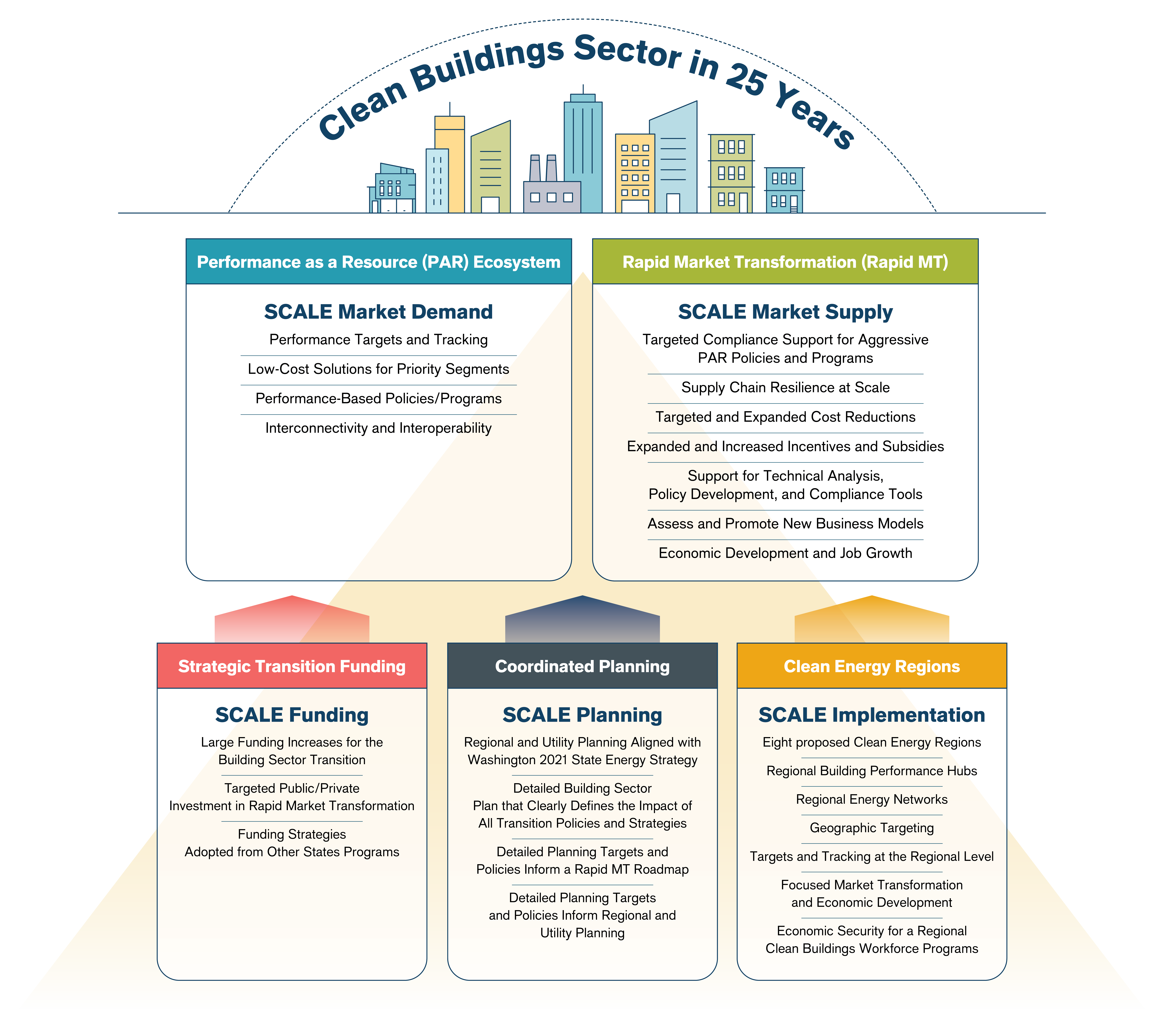
The SCALE 2030: Clean Buildings Transition Framework for Washington proposes five strategies to make this shift that inform the levers and actions detailed in the SCALE 2030 Clean Buildings Roadmap.

Explore Transition Framework Strategies
Performance as a Resource Ecosystem

Current Ecosystem

The current ecosystem for the clean buildings transition is not comprehensive. Major policies, such as the Washington Clean Buildings Performance Standard (CBPS), focus only on certain types of buildings and lack a complete set of interim targets. Utility incentives focus on energy efficiency rather than on emissions reductions. There is no universal method for valuing or communicating the performance of buildings. Overall, the building ecosystem lacks paths for all buildings to be part of reducing emissions and meeting economy-wide climate targets.  

Proposed Strategy

The Performance as a Resource (PAR) Ecosystem reorients policies, programs, and reporting to focus on whole-building performance as a resource for society and the electricity grid. It also aligns the transition of all building segments with statutory building sector targets supported by tracking, policies, programs, and market transformation efforts. PAR ensures that all buildings have a clear regulatory and programmatic trajectory to meet 2050 emissions reduction goals.

Rapid Market Transformation

Current Ecosystem

Barriers to a successful transition for buildings include high-cost zero-emission technologies, insufficient market capacity, and persistent dominance of high-emission equipment market share.

Proposed Strategy

Rapid Market Transformation (Rapid MT) complements the PAR Ecosystem Strategy by focusing on mainstreaming the adoption of the lowest-cost and highest-performing solutions to decarbonize key building segments. This involves increasing market development and investment for key technologies, such as heat pumps. It is essential that both the upfront and lifecycle costs of zero-emission, low-energy, flexible equipment become competitive with less efficient, fossil fuel-powered options. Workforce development that creates high-quality jobs is also crucial.

Strategic Transition Funding

Current Ecosystem

Funding is limited relative to what is needed to transition the building stock in Washington. Sources include Climate Commitment Act revenue that funds a variety of programs including grants and early adopter incentives; utility program incentives; some private financing; and some federal funding such as what Washington received from the Inflation Reduction Act.

Proposed Strategy

Washington must scale funding well beyond current levels to address the need for large scale investments in the building sector. A dedicated funding stream is needed specifically for modernizing and decarbonizing the building sector while ensuring equity and grid reliability. `

Coordinated Planning

Current Ecosystem

Many plans to address emissions reductions and clean buildings already exist in Washington, including the Washington 2021 State Energy Strategy, the 2021 Northwest Power Plan, and utility integrated resource plans and related conservation or demand-side management potential assessments. However, the agencies and organizations that produce these plans are not coordinated with aligned goals to transition buildings at the scale and pace needed to achieve the state’s 2050 emissions targets.

Proposed Strategy

Coordinated planning aligns state, regional, and utility energy and emissions planning efforts, timing, and interconnectivity. A coordinated planning strategy ensures all planning, policy development, and utility planning and program requirements support achieving Washington’s 2050 emissions limits and the Washington 2021 Energy Strategy’s recommended actions for the clean buildings transition. It clarifies the targets and timelines for electrification, efficiency, rooftop solar, demand flexibility, and virtual power plants statewide and integrates them into relevant utility, state, and regional plans.

Clean Energy Regions

Current Ecosystem

No single agency is responsible for implementing or coordinating a clean buildings transition to reach 2050 emission targets. The Washington Department of Commerce works at the state level, and utilities operate within their service territories with a focus on achieving efficiency requirements. Most cities and counties do not have the capacity to plan, coordinate, implement, or fund significant clean building transition efforts.

Proposed Strategy

Clean Energy Regions offer a regional approach to clean buildings implementation with eight regions that group counties, utility service territories, and air quality agencies. In addition to organizing areas of similar characteristics and acknowledging that each region has distinct challenges and opportunities to achieve clean buildings, this strategy recognizes that most towns and cities in Washington do not have resources to support large-scale clean buildings activities. Regions could adapt strategies that work for their specific building ecosystems and communities, lead implementation, and provide a one-stop shop for information and resources on clean buildings for building owners, occupants, contractors, local government entities, and utilities.
SIGN UP FOR CETI'S MAILING LIST
ROADMAPABOUT SCALE 2030CONTACTPrivacyDONATE to ceti
Seattle, WA